
Music and Math: The Surprising Connection
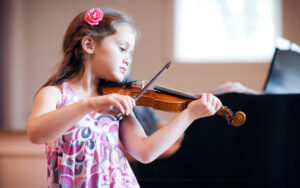
Have you ever heard someone say that music and math go hand in hand? It may sound surprising, but researchers and educators have recognized the connection for years. While music lessons are often associated with creativity and artistic expression, they also strengthen many of the same skills students use to succeed in mathematics.
Whether your child is just beginning piano lessons or already plays in an orchestra, learning music can help develop important mathematical thinking that benefits them both inside and outside the classroom.
How Are Music and Math Connected?
At first glance, music and math may seem like completely different subjects. One is creative, while the other is analytical. In reality, both rely on patterns, structure, sequencing, and problem-solving.
When musicians read sheet music, they constantly calculate timing, recognize patterns, count rhythms, and divide beats into fractions, all without realizing they’re using mathematical concepts.
For example:
- Whole, half, quarter, and eighth notes are based on fractions.
- Time signatures require counting and understanding numerical relationships.
- Musical scales follow specific mathematical patterns.
- Rhythm depends on precision, sequencing, and proportional thinking.
Every practice session gives students opportunities to strengthen these skills naturally.
Rhythm Builds Fraction Skills
One of the strongest connections between music and math is rhythm.
Students learn that:
- Two half notes equal one whole note.
- Four quarter notes equal one whole note.
- Eight eighth notes equal one whole note.
Instead of solving fraction problems on paper, students experience fractions through movement, listening, and playing. This hands-on learning often makes mathematical concepts easier to understand later in school.
Music Strengthens Logical Thinking
Learning an instrument requires students to think several steps ahead.
They must:
- Read notes.
- Count rhythms.
- Coordinate both hands.
- Listen carefully.
- Adjust mistakes in real time.
This combination of listening, analyzing, and responding strengthens logical reasoning and critical thinking; the same skills used when solving math equations.
Research Supports the Connection
Numerous studies have found positive relationships between music education and academic achievement, particularly in mathematics and spatial reasoning. While music lessons are not a shortcut to higher test scores, they encourage cognitive development by strengthening memory, attention, pattern recognition, and executive functioning; skills that also support success in math.
The greatest benefits come from consistent practice over time, combined with quality instruction and an encouraging learning environment.
Start Building Strong Minds Through Music
At American Music Institute (AMI), we believe music education develops the whole child. Our experienced instructors help students of all ages build confidence, creativity, discipline, and valuable cognitive skills while learning an instrument they love.
Whether your child dreams of performing on stage or simply wants to explore music for the first time, every lesson helps strengthen skills that support learning both in school and in life.
Ready to Begin?
AMI offers private music lessons for piano, violin, guitar, voice, drums, strings, woodwinds, brass, and more for students of all ages and skill levels.